 September 2023
—————————
In the Math Corner of my September 2023 Diary I posted the following brainteaser that I had looted from Southall & Pantaloni's charming little 2018 book Geometry Snacks: Bite Size Problems & How to Solve Them.

Prove that the three dark matchstick heads are collinear (that is, they lie on a single straight line).
—————————
• Solution
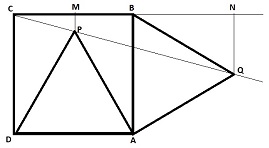
Forget about the dumb matchsticks, let's redraw it as a proper geometric figure, a square and two equilateral triangles (at right here).
That done, let's label it up. The square is ABCD, making the bases of the equilateral triangles DA and BA. Label the two so-far-not-labeled vertices of the triangles P and Q. Drop perpendiculars from P and Q to CB (extended as necessary); label the feet of those perpendiculars M and N.
Construct the lines CP, CQ and PQ. Yep, it sure looks like just one line, CP+PQ and CQ the same line, the angle CPQ equal to 180 degrees; but we have to prove it.
What can we say about the angle PCM? Well, its tangent is PM/CM.
I declare each side of the square to have length 2 units (inches, miles, nanometers, whatever). The sides of the equilateral triangles must likewise be 2 units long. The "height" (from vertex to midpoint of the opposite side) of each equilateral triangle is therefore, by Pythagoras' famous theorem, √3, so the length of PM is 2 − √3 units. The length of CM is of course 1 unit. The tangent of the angle PCM is therefore 2 − √3 units.
What about the angle QCN? Remember: We don't know at this point that CPQ is a single straight line. That's what we are trying to prove.
The tangent of the angle QCN is QN/CN. QN has length 1 unit (half a side of the square); CN has length 2 + √3 (one side of the square plus one height of a triangle). The tangent of the angle QCN is therefore 1 / (2 + √3)
That's a fraction with a numerator (top) equal to 1 and a denominator (bottom) equal to 2 + √3. The value of a fraction remains unchanged if you multiply top and bottom both by the same thing. Okay, let's multiply top and bottom by 2 − √3. New top: 2 − √3. New bottom: (2 − √3) × (2 + √3). By the well-known identity (a − b) × (a + b) = a² − b² this is actually 2² −(√3)², which is to say 4 − 3; so our new bottom is 1.
The tangent of the angle QCN is therefore 2 − √3. That's the same as the tangent of the angle PCM. CQ and CM are therefore the same line. QED.