 July 2024
—————————
In the Math Corner of my July 2024 Diary I posted the following brainteaser with the note that: "I have borrowed this one from Catriona Shearer, who has a million of 'em. (Click on PuzzlePages here.)"
Brainteaser:

The line segments here connect corners of the square to midpoints of the sides. What proportion of the square is yellow?
—————————
• Solution.
This is one of those puzzles that leave me with the nagging feeling that there may be some swift, clever solution that I just couldn't find.
If there is, I just couldn't find it. To solve the puzzle I resorted to breaking rocks.
First note that the diagram is north-south symmetrical. Draw a horizontal line halfway up, compute the yellow area above the line, then multiply by two for the solution.
To compute that yellow area I divided it into triangles then calculated the area of each triangle using one of the familiar formulas:
half base times height, or
half the product of two sides times the sine of the angle between them.
To start off the rock-breaking and show how it goes, I'll tackle the triangle ADE.
First, note that because of similar triangles AIE, AHJ, etc., all the four angles at E are right angles. (It's even easier to see if you draw the other four corner-to-midpoint lines, JB etc.)
It also helps to tag angle BAC, say as α. Obviously tan(α) = ½. Equally obviously, angle EAI is also α. Since angle AEI is 90°, the length AE must be twice the length EI to make that tangent come out right.
Taking this to be a unit square, the length AI is ½. By Pythagoras' Theorem therefore, EI² + 4EI² = 1/4. So EI = 1/(2√5) and AE = 1/√5.
Turning our attention now to triangle ADE, whose area we want to find: it's another right-angled triangle, we know that length AE is 1/√5, and angle DAE is 45° − α. Applying the tangent subtraction formula to the facts that tan 45° is 1 and tan α is ½, the tangent of angle DAE is ⅓.
Length ED is therefore 1/(3√5). Half base times height: the area of triangle ADE is 1/30.
And so on. Proceeding in like manner with the other triangles, and aided by the construction lines I have drawn in and some more basic
trig, we eventually get.
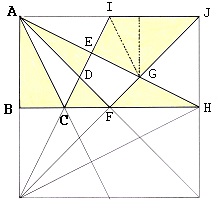
- ABC: 1/16
- ADE: 1/30
- DCF: 1/48
- FGH: 1/24
- GIJ: 1/12
- EGI: 1/30
If you add all those up you get 11/40. Since that's only the top half of the square, the total yellow area is 11/20, or 55 percent.