—————————
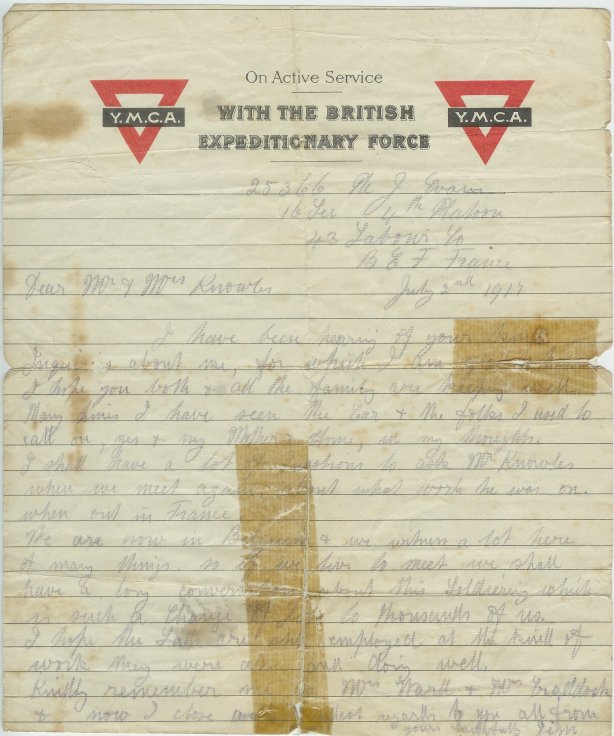
 Transcription of Letter
On Active Service
With the British
Expeditionary Force
25366 Mr J Evans[1]
16 Sec 4th Platoon
43 Labour Co
B E F France
July 2nd 1917
Dear Mr & Mrs Knowles
I have been hearing of your kind Inquiries about me, for which I am glad […] I hope you both & all the
family are keeping well. Many times I have seen the Car[2] & the
folks I used to call on, yes & my Mother & home, in my thoughts. I shall have a lot of questions to ask Mr
Knowles when we meet again about what work he was on when out in France.[3]
We are now in Belgium & we witness a lot here of many things, so if we live to meet we shall have a long
conversation about this soldiering which is such a change of job to thousands of us. I hope the lads are still
employed at the kind of work they were at and doing well. Kindly remember me to Mrs Ward & Mrs
Craddock.[4]
now I close with my best regards to you all from
Yours faithfully
Jim
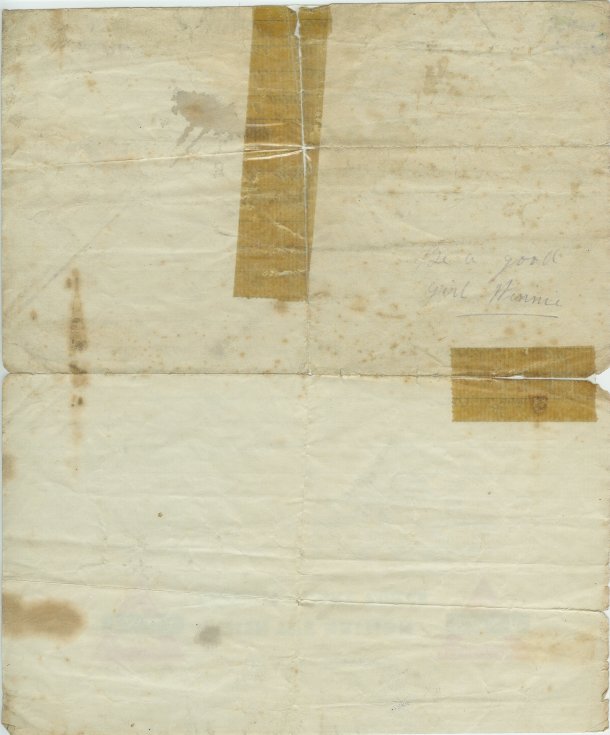
[Reverse of letter] Be a good girl Winnie[5]
—————————
Notes
- Jim Evans was a young Hednesford man — "a baker, or a baker's boy," says Muriel — with whom my grandparents were friendly. Muriel thinks he may have been an orphan to whom they had shown some kindness.
- I'm pretty sure this is "Car" — compare the capital "C" in "Craddock," further down in the letter. I have no idea what it means, though. I thought it might be a local word for some part of a colliery's equipment. The OED supplement gives "cage of an elevator" as one meaning of "car," and the elevator that took miners underground might have been a "car." But why the capital letter?
- This refers to Jack Knowles's own service in France — see here.
- Mrs Ward was Grandma Knowles's best friend. They helped each other through pregnancies, of which (according to Muriel) Mrs Ward had almost as many as Grandma. "They never addressed each other by first name. It was always 'Mrs Ward' and 'Mrs Knowles'," says Muriel. Mrs Craddock was another neighbor.
- My aunt Winifred, 11 years old here, of whom Jim was particularly fond.